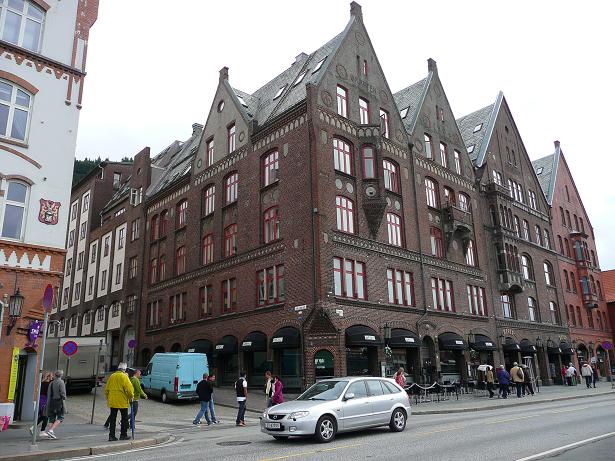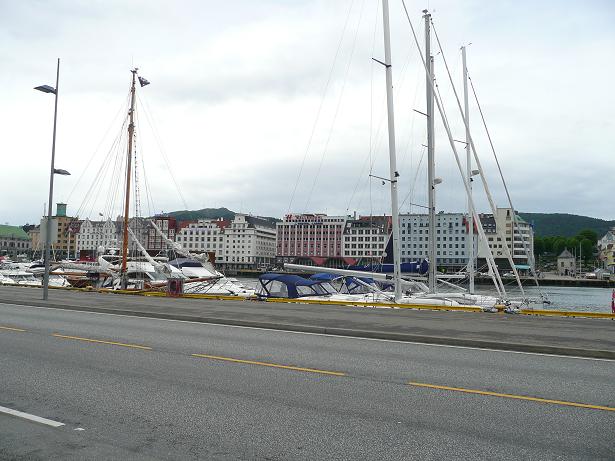

Bergen greeted us with light rain and grey skies, and somehow it didn’t exactly inspire optimism. Z. decided to lug an umbrella around, as if we didn’t have warm jackets or anything. I’m more worried about the heat than a bit of drizzle.
Bergen przywitało nas lekkim deszczem i szarością i jakoś tak nie nastrajało optymistycznie. Z. postanowił targać parasol, jakbyśmy nie mieli ciepłych kurtek ani nic. Bardziej obawiam się gorąca niż jakiejś mżawki.
Not far from the harbor, on Slottsgate, lies Bergen’s first attraction: /Niedaleko portu, przy ulicy Slottsgate jest pierwsza atrakcja Bergen:
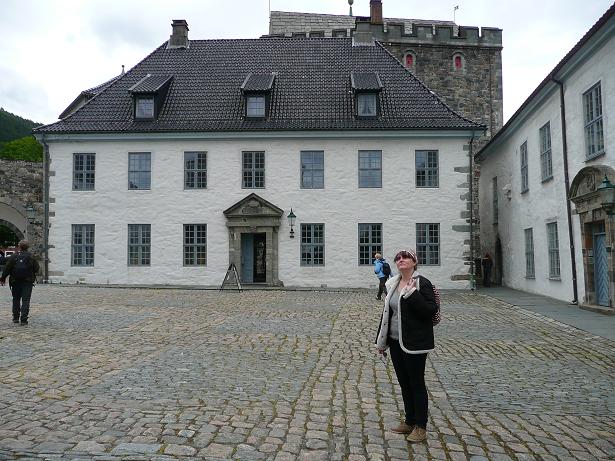
Håkonshallen is part of the Bergen fortress, built in the 13th century as a royal ceremonial hall. It was first used for such events by King Magnus Håkonsson and the Danish Princess Ingeborg; the celebration was quite a bash, lasting three days and two nights and attended by over a thousand guests. In the 16th century, the Danish governor Erik Rosenkrantz commissioned Scottish architects to build a stone tower housing both dungeons (grim) and the governor’s apartments (cozy), with cannon emplacements on the upper level. In 1944, a Danish ammunition ship exploded in the nearby harbor, causing extensive damage. Both the tower and the hall were subsequently rebuilt, and since 1966, the site has been one of Bergen’s tourist attractions.
Håkonshallen: część fortecy Bergen, zbudowana w 13 wieku jako dwór królewski służący do ceremonii. Pierwszy raz został użyty do tych celów przez króla Magnusa Håkonsson i księżniczkę duńską Ingeborg. Imprezka była niezła, bo trwała 3 dni i 2 noce, a gości przybyło ponad 1000. W 16 wieku duński gubernator Erik Rozenkrantz zlecił szkockim architektom budowę kamiennej wieży, w której zmieściły się i lochy (dzikie), i gubernatorskie apartamenty (przytulne), a na wyższym poziomie stanowiska armat. W 1944 roku duński statek z amunicją eksplodował w pobliskim porcie, co spowodowało ogromne szkody. Wieżę i dwór odbudowano, a od 1966 roku jest jedną z atrakcji turystycznych Bergen.
Below: Håkon’s Hall in Bergen. I’m staring at the Rosenkrantz Tower. / Poniżej: Bergen Hakonshallen. Gapię się na wieżę Rosenktantza.
Near the fortress, also on the northern side of Vågen, stands the oldest building in Bergen: / Nieopodal fortecy, również po północnej stronie Vågen stoi najstarsza budowla w Bergen:
Mariakirke – St. Mary’s Church – was built in the 12th century in the Romanesque style, the only one considered proper and prevailing at the time. Over the centuries, it acquired a Gothic choir and a Baroque pulpit. For three centuries, it served as the parish church for Hanseatic merchants.
Mariakirke – kościół św. Marii. Zbudowano go w 12 wieku, w stylu romańskim, czyli jedynym słusznym i obowiązującym w tamtych czasach. W ciągu wieków istnienia dostał gotycki chór i barokową ambonę. Przez 3 wieki był kościłem parafialnym dla hanzeatyckich kupców.
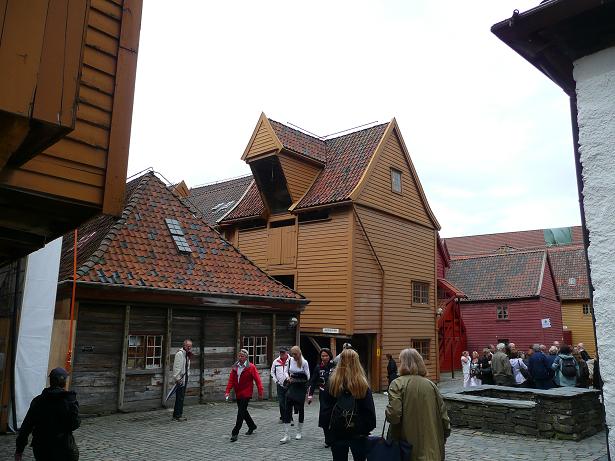
We continue along the northern side of the harbor and unexpectedly find ourselves at Bergen’s biggest tourist attraction: the waterfront known as Bryggen. These are the warehouses and merchant houses from the era of the Hanseatic League. The original structures were destroyed by fire; the current ones are stone replicas. The Hanseatic Museum is housed in the only original building, which dates back to the 18th century. The ground floor served as a storage area for goods, while the first floor contained the living room and offices. The top floor held the merchants’ sleeping quarters—tiny cubicles that could fit nothing more than a bed.
Idziemy dalej wzdłuż północnej strony portu i niespodziewanie wkraczamy do największej atrakcji turystycznej Bergen: nabrzeża zwanego Bryggen. Są to magazyny i domy kupców z czasów Ligi Hanzeatyckiej. Te stare zostały zniszczone przez ogień, te obecne są ich replikami z kamienia. W jedynym oryginalnym budynku z 18 wieku mieści się Muzeum Hanzeatyckie. Parter był składnicą towarów, na pierwszym piętrze mieścił się pokój dzienny i biura. Na najwyższym piętrze były sypialnie kupców – malutkie kliteczki, w których mieściło się tylko łóżko.
Below: behind Bryggen. / Poniżej: na tyłach Bryggen.
The guests were forbidden to heat their quarters or even light them, for fear of fire. Merchants remained celibate throughout their entire stay in Bergen. Well, it was a harsh law, but the law nonetheless.
Gościom nie wolno było ogrzewać pomieszczeń, ani nawet ich oświetlać, w obawie przed ogniem. Kupcy pozostawali w celibacie przez cały okres pobytu Bergen. Cóż, twarde prawo, ale prawo.
to be continued / c.d.n.